e/Crit-s
Hu Di, David Jang, Michele Lorusso, Mieke Marple, (A)Provisional-Collective, Xi Qin and Yixuan Tan
Curator: Tom Leeser
Assistant Curator: Dongpu Ling
03/21/26 - 04/25/26
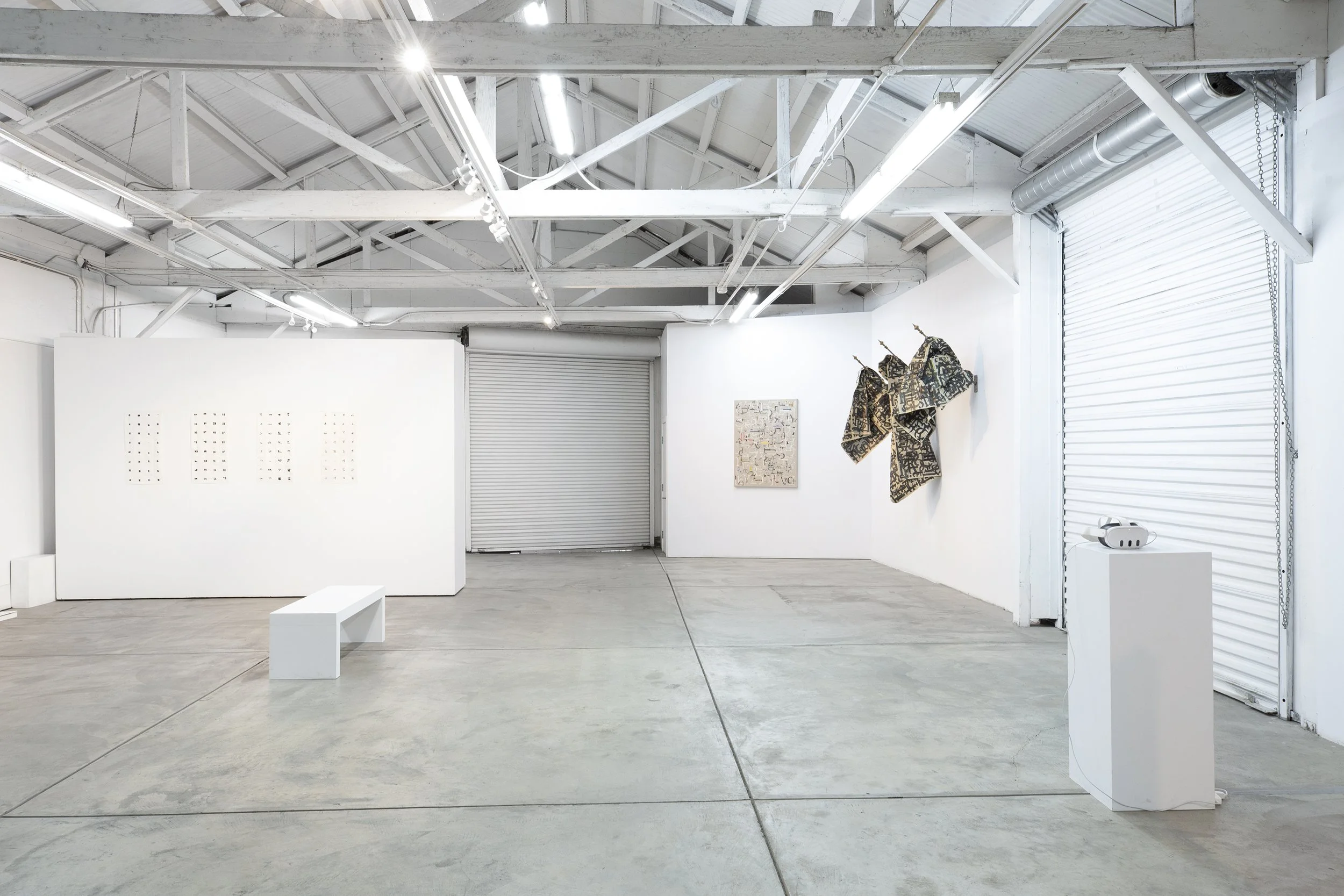
Phase Gallery is pleased to present a group exhibition e / Crit - s with the works by: Hu Di, David Jang, Michele Lorusso, Mieke Marple, (A)Provisional-Collective, Xi Qin and Yixuan Tanis, curated by Tom Leeser.
e / Crit - s is an exhibition that asks the question, what does it mean to “inscribe” when technological mediation has inverted and encrypted contemporary language? What emerges is not a singular portrait of crisis, but a network of interpretations of memory, metaphor, and conjecture, marked by erasure and complexity and shaped by a time of uncertainty and accelerated impermanence.
The exhibition, curated by Tom Leeser, serves as a critical space for a diverse coalition of artists, offering aesthetic interrogations of re/writing, through abstraction, concealment, robotics, assemblage and virtuality. e / Crit - s sends us beyond the material surface of the “logos” and into its hidden structures, to reveal both its ghosts and its shadows. It re/cognizes the tenuous nature of the word itself and the sociopolitical forces that are bending and blending it through conflict and dissonance.
e / Crit - s reflects the collective strategies of the artists who re/invent and re/mix systems of communication. It asks us to consider how we perceive the parallel worlds we choose to inhabit. Advocating for a new culture of literacy, the work combines embodied experience with material critique. It is a way of imagining language through fragmentation and disassembly; a paradoxical practice of writing that is not meant to be read, but to be seen and heard, leading us to new ways of knowing.
_________________
Exhibiting artists:
Hu Di is a scientist and artist based in Los Angeles. She obtained her bachelor’s degree in physics from Beijing Normal University in 2015 and her master’s degree in computer science and technology from Zhejiang University in 2018. During her time at IBM as a data scientist, she also explored the integration of art and tech in her creative endeavors. Following the post-pandemic era, Hu Di decided to shift her primary focus to the arts. Hu Di received their MFA in the Art Program at CalArts. Her creative practice encompasses interactive installations, performances, participatory activities, and painting. She has created multiple solo exhibitions and has recently collaborated with other artists in fields ranging from art to theater.
David B. Jang is an artist working across technology, biology, and kinetic systems. His practice spans installation, performance, sculpture, painting, and generative drawing, often integrating biometric sensors, robotic systems, and algorithmic processes. Through these data-driven ecosystems, Jang translates physiological signals and human perception into mechanical motion and visual expression, creating feedback loops between body, machine, and environment. Exploring the cyclical relationship between creation and decay, Jang’s work examines how technology mirrors organic life and how identity is negotiated within hybrid systems of control, automation, and desire. His projects investigate what it means to be human in an increasingly hybrid world, where the boundaries between living and artificial, emotion and mechanism, blur into continuous transformation.
Michele Lorusso explores the discursive potential of certain materials and objects, addressing their symbolic and poetic dimensions. For him, materials and objects serve as tools that allow him to speculate and visualize narratives related to identity, duality, the future, and memory. He was invited to be an artist-in-residence at LACMA (January—August, 2025). He has activated happenings with an anonymous gallery at public parks in NY, poetic readings at Performance Space NY, and future epistolary exercises at libraries, farms, and museums. He is a founding member and co-director of VISA PROJECTS, a project or curatorial vehicle for the exhibition of a generation of Mexican artists in the United States, and he is also part of a collective called Grupo Ñ with Sophia Le Fraga and Pedro Verdin, an all Latinx artist collective from the graduating CalArts MFA Art Program of 2025.
Mieke Marple is an artist and writer living in Los Angeles. Marple has exhibited internationally, including in "Techno-Healing" at the Museum of Contemporary Art Zagreb, and "Elan Vital" at MOCA Westport. She has been written about by The New York Times, W Magazine, The Guardian, Fortune, and Autre, among other publications. She has written for The Huffington Post, LA Review of Books, and McSweeney’s, among others. Through various charity art auctions, she has helped raise over a million and a half dollars for Planned Parenthood LA and a quarter million for the prison abolitionist organization Critical Resistance. She received a B.A. in Fine Art from the University of California, Los Angeles, in 2008 and was co-owner of Night Gallery, 2011-2016. Her work is in the collection of the Museum of Crypto Art, Seattle NFT Museum, and McEvoy Family Collection.
A)Provisional-Collective is the cultural practice of media artist Tom Leeser. Since 2012, (A)Provisional Collective has employed a wide range of media, resulting in public artworks, digital videos, immersive installations, sound-based works, and socially engaged educational projects. The collective was founded with the intent of exploring temporary experimental practices that can occur in and around public media spaces, alternative cultural institutions, and in our everyday environments. This multidisciplinary practice has engaged topics such as climate change, education within a globalized context, cultural memory, and speculative futures. With backgrounds in photography, film, video, and sound, the point is to perform within a critical relationship between art and life through a reconsideration of media, aesthetics, technology, and the body politic.
Xi Qin is a Los Angeles-based artist who completed their MFA in Art and Technology and Integrated Media at CalArts in 2025. Their practice involves making conceptually-driven sculpture and installation work focused on technology, identity, the body, and history through a process of deconstruction, re-materialization, and metaphor. At times, art and its critique elude or oppose our desire for reason. It affords us a temporal respite, a spatial freedom to delve into a poetical zone for memory, a non-representational and indirect wandering and conjuring. Xi’s work functions within this autonomous zone, leaving us in a state of wonder and at times, in awe.
Yixuan Tan is aLos Angeles-based artist. The VR and AR work of Yixuan Tan projects an intermediary condition between his interest in Buddhism as a philosophy and the technical and aesthetic nature of virtual worlds. There is a perceptual displacement in his work; he examines the idea that truth is fluid and dynamic, moving through time. He makes work from personal experience and his rigorous process of creative research. He’s constantly learning, and through his practice as an artist, he always maintains a natural curiosity.